The Revenge of Color: Why We Are Abandoning “Sad Beige” for Dopamine Decor
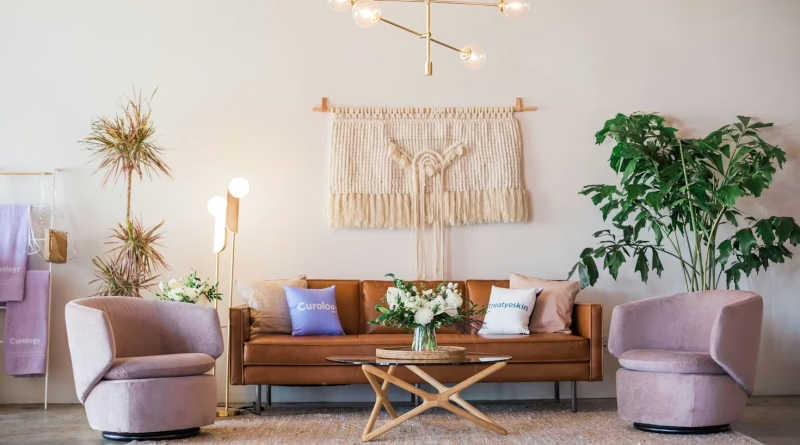
For the better part of the last decade, the aesthetic landscape of our lives was dominated by a single, overwhelming philosophy: Minimalism. Influenced by Scandinavian design, the Apple store aesthetic, and the perfectly curated feeds of lifestyle influencers, our homes became shrines to the void. Walls were white, furniture was greige (that distinct purgatory between gray and beige), and surfaces were aggressively empty. We were told that clutter was a moral failing and that a clean, sterile space equaled a clean, organized mind. It was the era of “Millennial Minimal,” often derisively referred to as “Sad Beige.”
But recently, the pendulum has swung back with violent, joyful force. A new movement has taken over social media feeds and living rooms alike, dubbed “Dopamine Decor” or “Maximalism.” This isn’t just a change in color palettes; it is a full-scale rebellion against the idea that our homes should look like unlived-in museum exhibits. We are seeing a return to vibrant colors, clashing patterns, gallery walls packed with art, and shelves overflowing with weird, sentimental knick-knacks.
The driving force behind this shift is largely psychological, rooted in our post-pandemic reality. During the lockdowns, we spent years staring at our own four walls. When the world outside felt chaotic and dangerous, the minimalist white box initially felt safe and clean. But as the isolation dragged on, those white walls began to feel less like a sanctuary and more like a padded cell. We realized that sensory deprivation isn’t soothing; it’s depressing. We started craving visual stimulation, warmth, and environments that actually sparked joy rather than just suppressing stress.

Dopamine Decor: Treating the home as a source of energy, not just a void.
There is also a strong narrative of identity at play here. Minimalism, by its very definition, strips away personality. If you walk into a strictly minimalist apartment, it is often impossible to tell who lives there. It could belong to a graphic designer, a banker, or a serial killer; the lack of objects erases the inhabitant. Maximalism, on the other hand, is an exercise in storytelling. It puts your life on display. Your collection of vintage mugs, the stack of dog-eared books, the weird ceramic frog you bought in Mexico—these things tell a stranger exactly who you are.
This trend also aligns with the rise of sustainability and thrift culture. The minimalist aesthetic often requires buying expensive, high-end furniture that fits a very specific, sleek profile. Maximalism, however, thrives on the second-hand. It encourages the mixing of eras and styles. A mid-century modern chair can sit next to a Victorian lamp and a 1980s neon sign. It celebrates the “hunt” of thrifting and estate sales, allowing people to build a home slowly with objects that have history and soul, rather than ordering a matching set from a catalog.
Of course, critics often confuse Maximalism with messiness, but there is a distinct difference between “Cluttercore” and hoarding. Successful maximalism is curated chaos. It requires a keen eye to layer textures and colors so that the room feels cozy rather than claustrophobic. It is about abundance, not garbage. It reflects a confidence in one’s own taste—the bravery to say, “I like this bright orange rug, and I don’t care if it doesn’t match the curtains.”

Curated Chaos: Every object has a story to tell.
Social media has played a fascinating, contradictory role in this. While Instagram popularized the “sad beige” aesthetic, TikTok has popularized the “lived-in” look. We are seeing a rejection of the “show home” performance. Gen Z, in particular, seems allergic to the corporate sterility of the previous generation’s design choices. They want spaces that feel weird, specific, and fundamentally human.
Ultimately, the death of strict minimalism is a sign that we are done trying to optimize our lives for perfection. We are accepting that life is messy, colorful, and loud, and our homes should reflect that. A house is not meant to be a calm, empty void where nothing ever happens; it is meant to be the backdrop for a life fully lived, filled with things that make us smile when we walk in the door.